 Study Plan
2110 Topo
Study Plan
2110 Topo

In SMPTE ST 2110 networks, Precision Time Protocol (PTP / IEEE 1588) keeps all devices synchronized. The key calculations for clock offset and path delay happen on the slave side — not the grandmaster, and usually not in switches (unless they're boundary clocks).
Quick Summary: Who Computes What?
| Component | Computes Offset & Delay? | What It Actually Does |
|---|---|---|
| Slave / Endpoint (cameras, servers, multiviewers, etc.) | Yes — main calculator | Collects the 4 timestamps (T1–T4), runs the offset and delay formulas, continuously adjusts its local clock via servo loop. |
| Grandmaster / Master Clock | No | Only provides accurate timestamps (T1 for Sync, T4 for Delay_Response). Keeps it simple and scalable. |
| Transparent Clock (in switches) | No (but compensates) | Measures residence time inside the switch and adds correction fields to Sync/Follow_Up messages — helps slave's math stay accurate. |
| Boundary Clock (edge clocks in switches) | Yes (as slave to upstream) | Acts as slave → computes offset/delay for itself → then becomes master to downstream devices, regenerating clean time signals. |
| Unaware switch/router | No | Adds uncontrolled delay/jitter — avoid for precision; can degrade accuracy over hops. |
Key takeaway: The endpoint (slave) does the heavy lifting on calculations. Boundary clocks (common in broadcast switches) also compute when they act as slaves upstream, making them crucial for scaling and isolating network segments in large or multi-facility setups.
Visual Examples of PTP Flow and Architecture
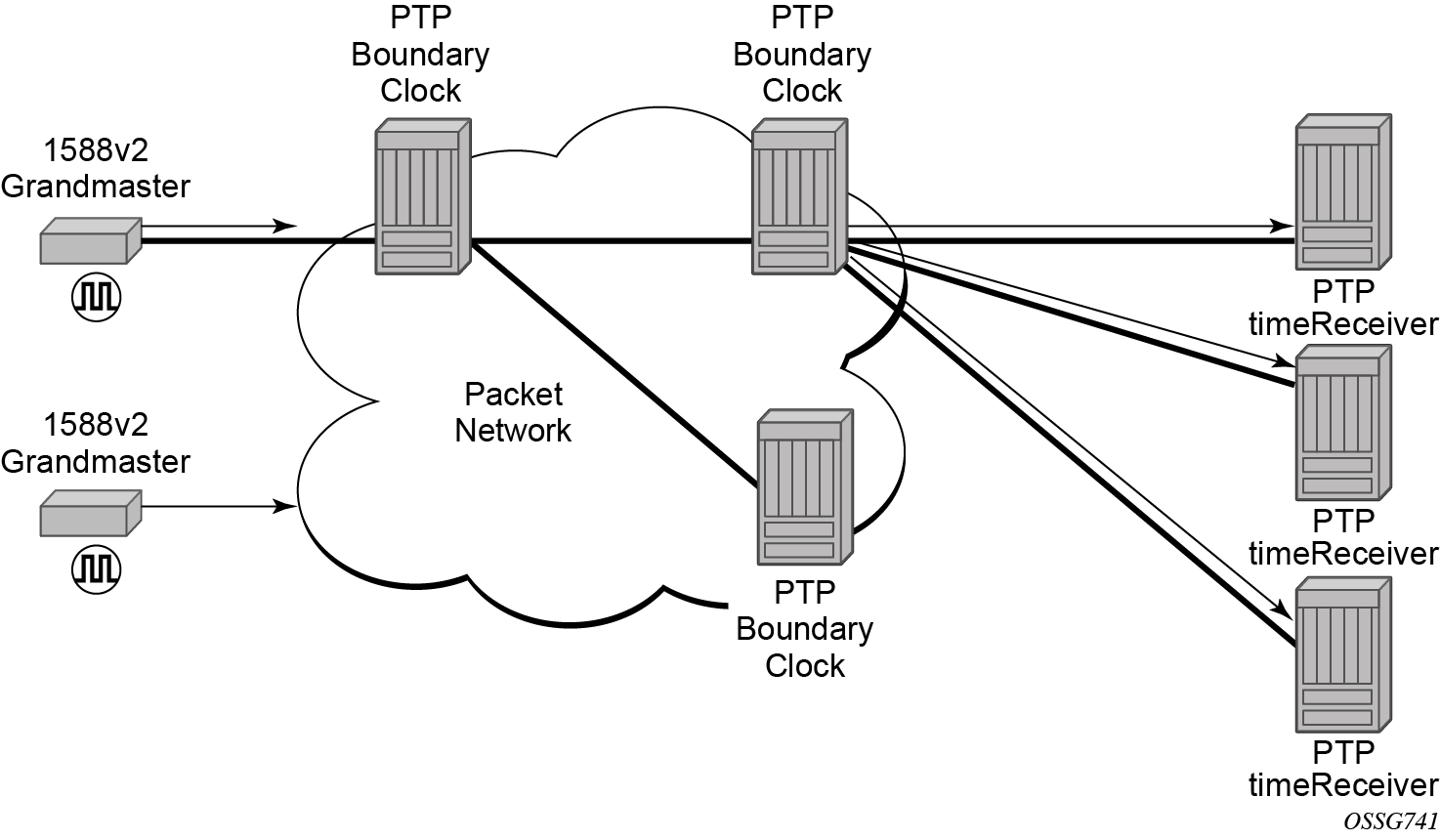
Hierarchical PTP topology with Grandmaster feeding multiple Boundary Clocks, which then distribute to timeReceivers (slaves). From Nokia documentation.
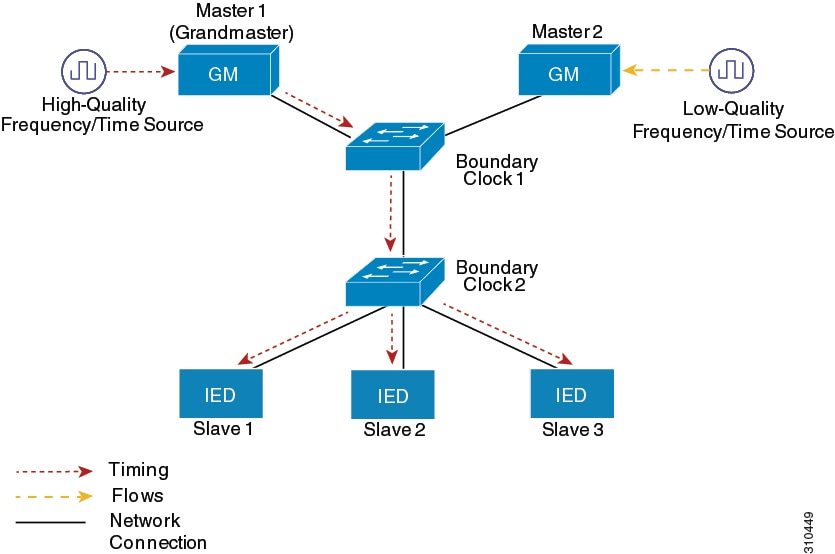
Cisco example: Grandmasters feeding a Boundary Clock, which then synchronizes downstream slaves (IEDs/endpoints). Shows redundancy with multiple masters.
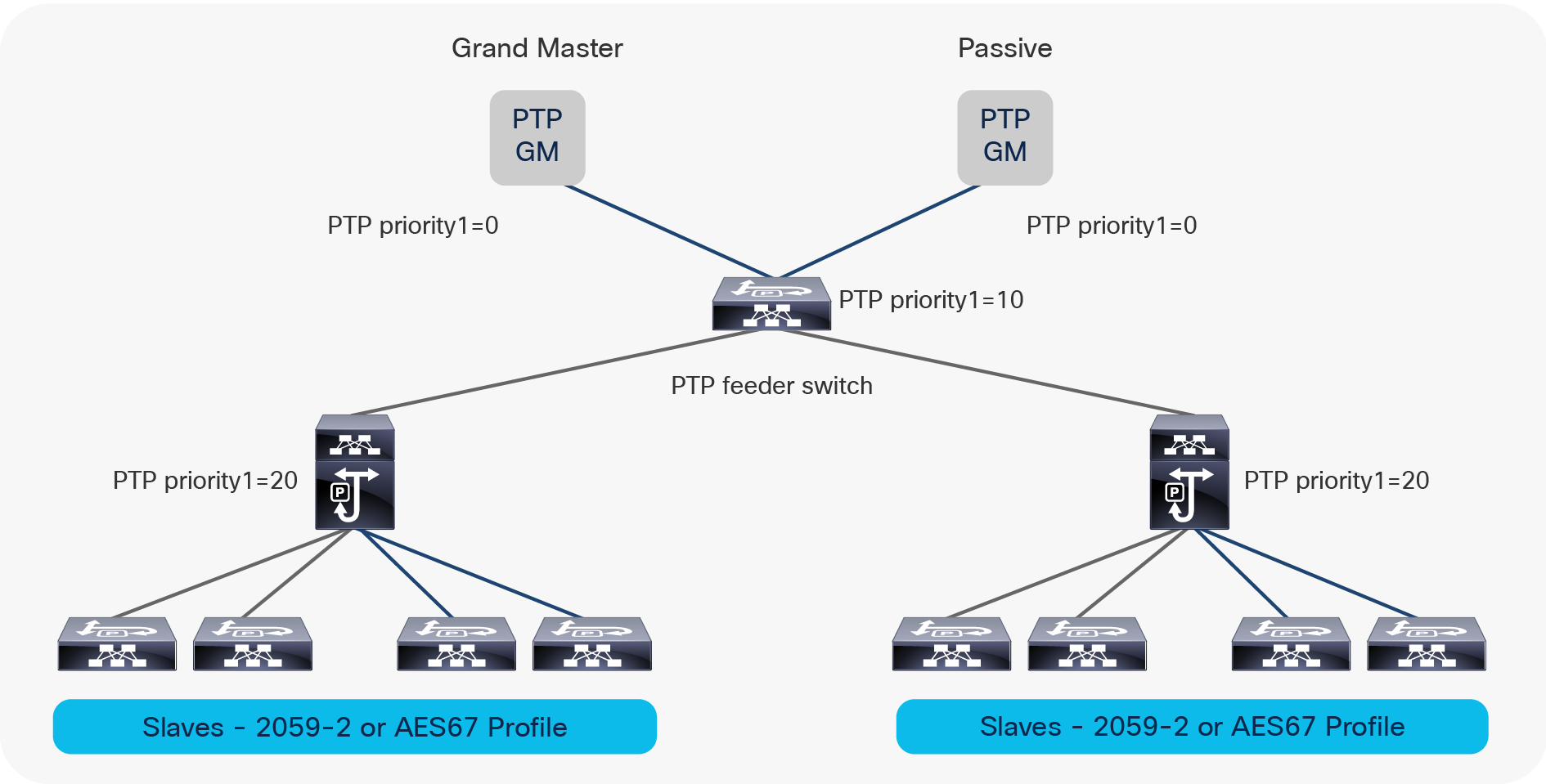
Typical ST 2110 PTP setup: Grandmaster(s) → PTP feeder switch (often with boundary clock functionality) → endpoint slaves (cameras, audio devices, etc.). From Cisco IP Fabric for Media guide.
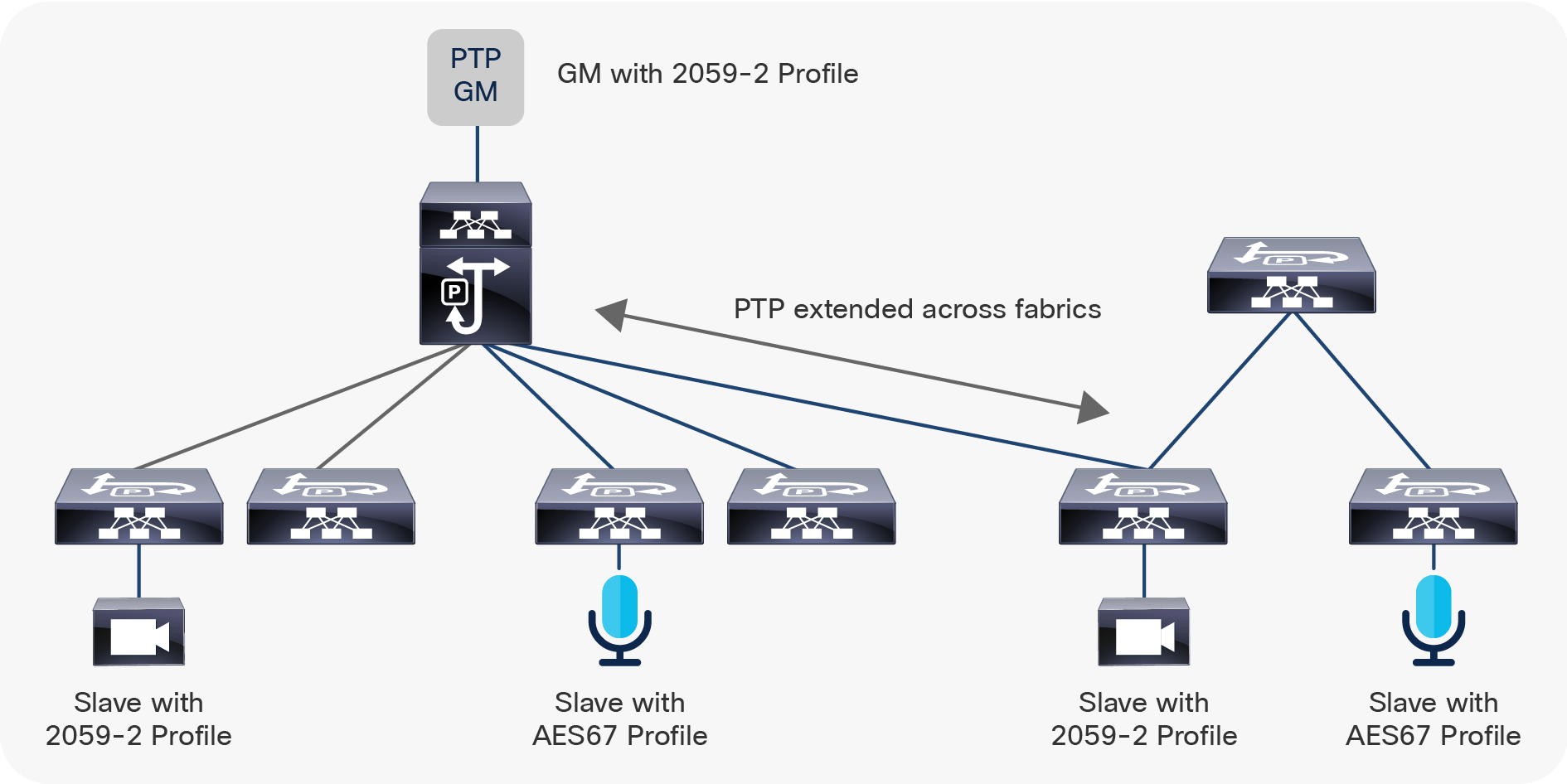
PTP extended across multiple fabrics/switches, with boundary clocks maintaining sync to slaves on both sides. Cisco reference.
For more details, check the linked pages in your PTP section or dive into SMPTE ST 2059-2 profile specifics.